Blackwall
Blackwall, Tower Hamlets
A historic riverside district situated east of Poplar
Blackwall’s name probably derives from the embankment built to prevent tidal inundation, although there is a story King Alfred had a weir constructed nearby to strand invading Danish ships that had sailed up the River Lea.
The first wharves appeared at Blackwall in the late 15th century. This was later than the developments between St Katharine’s and Limehouse but 200 years before the adequate drainage of Stepney Marshes allowed waterfront construction on what became the Isle of Dogs, so Blackwall long remained an isolated satellite of the Port of London. Shipbuilding and repairs were carried on, and the Mary Rose was refitted here in 1514.
Blackwall had a proud maritime tradition and both Raleigh and Nelson are said to have had homes here. The first colonists of Virginia sailed from Blackwall in 1606 and later the East India Docks brought thriving international trade.
Today, Blackwall is best known for its tunnels under the Thames, constructed in 1897 and 1960.
Until relatively recently Blackwall had a declining residential population and a high level of social deprivation, but luxury riverside apartments began to be added from the late 1980s.
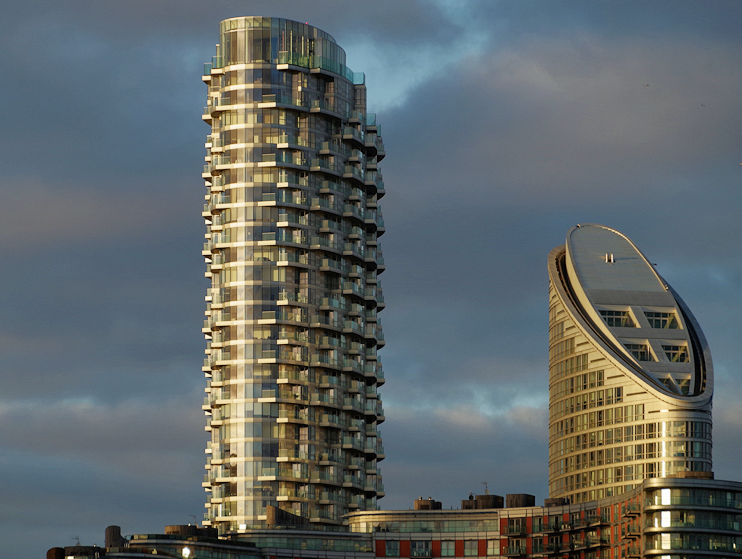
The largest of these schemes is New Providence Wharf, which was completed in 2016. Its fraternal twin towers – 43-storey Providence and 31-storey Ontario – are shown in the photograph at the top of this article.* As is often the case in Docklands, the developers made no attempt to establish any connection with the neighbouring community or with the locality’s significant heritage; New Providence Wharf’s early promotional literature referred, without apparent irony, to “this brave new world.”
Postal district: E14
Population: 19,461 (Blackwall and Cubitt Town ward, 2011 census – a 63 per cent increase on 2011)
Station: Docklands Light Railway, Beckton branch (zone 2)
Further reading: Hermione Hobhouse (editor), Survey of London: Poplar, Blackwall and the Isle of Dogs, the Parish of All Saints v. 43 & 44, Athlone Press, 1999