
Crossness
Crossness, Bexley
Now an outpost of Thamesmead, this was an isolated spot when Victorian engineers chose it as the site for one of their grand public engineering projects
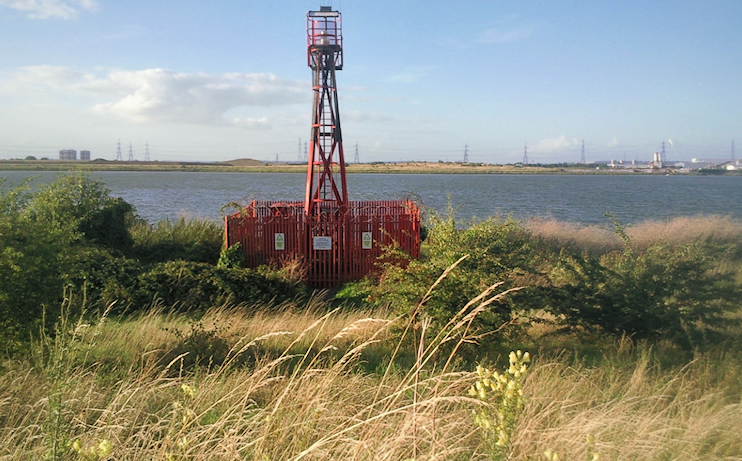
The original Cross Ness is a promontory in what is now north-east Thamesmead. Cross Ness’s name does not seem to have appeared in print before the early 19th century and its derivation is uncertain – but presumably a cross once stood here. A ‘ness’ is a headland and the term has the same root as the word ‘nose’. The photograph above shows Cross Ness Light,* and its location is marked with a lighthouse symbol on the map below.
Sewage pollution had become a serious health hazard in London by the mid-19th century and the ‘great stink’ of 1858 finally persuaded parliament to act.
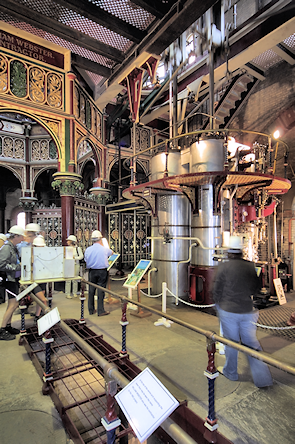
Joseph Bazalgette and his colleagues devised and built a network of sewers that carried the city’s waste water to two huge pumping and filtration stations on either side of the Thames, east of the metropolitan conurbation.
At the northern edge of the Erith marshes, the four massive engines of Crossness pumped effluent into a reservoir that held 25 million gallons.
Opened by Prince Albert in 1865, the building was designed in ornate Romanesque style in gault brick, ornamented inside with painted ironwork.
The old engines were decommissioned at the end of the 1950s and the machinery fell victim to rust and vandalism. Its deterioration continued until the establishment of the Crossness Engines Trust in 1985.
A team of volunteers progressively restored the old machinery and began to show the results to the public in 2001, with an accompanying exhibition on the history of sanitation, housed in the only grade I‑listed industrial building in south-east London.
Funding from a number of sources, including the Heritage Lottery Fund and English Heritage, has recently enabled a programme of further improvements, primarily some structural repairs and enhanced visitor facilities. After a long period of closure to the public except on occasional Sundays, Crossness reopened in July 2016. See the trust’s website for the latest information on forthcoming ‘public steaming days’.
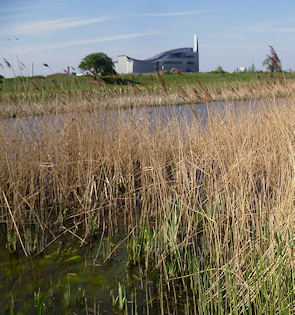
Thames Water now uses modern technology elsewhere on the site, which it continues to expand, notably with the construction in 1998 of the sewage sludge incinerator, which is shown in the photograph on the right.
As with all waste water plants there are problems with bad odours and hundreds of sprays have been mounted around the works to squirt perfume into the air on hot days.
The surrounding marshland is a 50-acre wetland nature reserve and Thames Water has made use of redundant concrete pilings to create an artificial cliff with nesting ledges for birds and a bat cave behind. Most of the nature reserve is freely open to the public but a fenced area is restricted to members of a ‘friends scheme’.