
Cudham
Cudham, Bromley
A quiet village with several flint and red brick buildings, lying two miles east of Biggin Hill
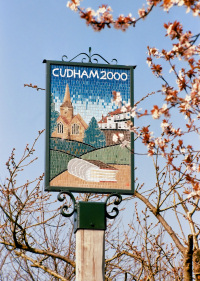
Cudham’s church of St Peter and St Paul is of twelfth century origin, though much restored since. There is evidence that there has been a place of worship on this site since 900bc and two yew trees in the churchyard may be 17 centuries years old. Local landowners have often been of noble birth but none has ever chosen to live in the village.
In 1865 Richard Relph acquired the Blacksmith’s Arms, a property that dates from 1628. As the name suggests, it was originally a smithy. Relph’s wife bore him fifteen children, one of whom – born at the inn when the landlord was at a remarkably advanced age – went on to become the celebrated music hall star Little Tich. The pub features in the village’s millennial sign, shown in the photograph.
The houses and cottages of Cudham date mainly from the 19th century. Cudham Hall served until recently as a trade union-run engineering college but has since been converted to apartments. The Angas Home has been a vicarage and a sailors’ convalescent home. It’s now a private house and was valued at around £2,750,000 in 2012.
The surrounding farms were once known for growing dyer’s weed (Reseda luteola), which produces a yellow pigment. Its cultivation ceased when synthetic competitors rendered it uneconomic.
Run by the Woodcraft Folk, Cudham environmental activities centre is set within a three-acre woodland site on New Barn Lane. It has a residential field studies unit, a camping area and a mini-farm.
Postcode area: Sevenoaks, TN14