
Newington
Newington, Southwark
The correct name for the area that’s generally called the Elephant and Castle to avoid confusion with Stoke Newington
It seems likely that Newington (which means ‘new farmstead’) grew up after about 1200, when the establishment of nearby Lambeth Palace brought increased traffic along the Kent road.
Until the second half of the 18th century Newington remained a sparsely populated farming village with a little industry, notably the manufacture of clay tobacco pipes. Thereafter, new roads brought development opportunities and landowner Henry Penton (who created Pentonville) began to sell off some of his farmland.
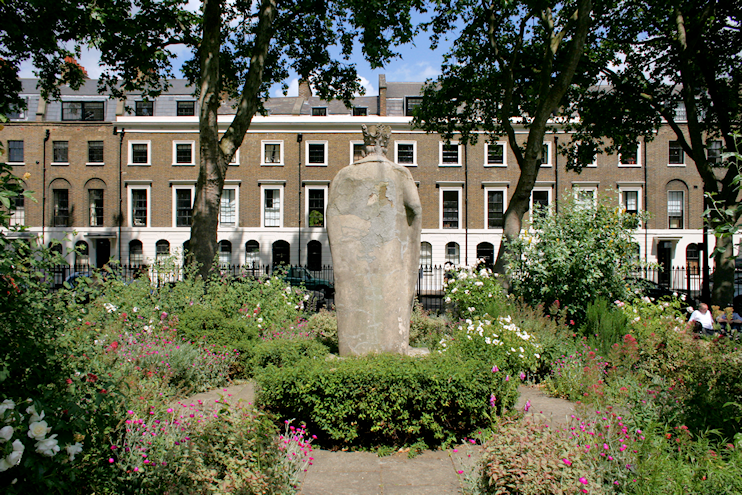
The 19th century saw increasingly dense housebuilding, mainly speculative but some philanthropic. Trinity church was built in 1824 on land in the north of the parish that has belonged to the Corporation of Trinity House since 1661. The surrounding square was then laid out with smart terraced houses, some of which have since been converted laterally into flats across two or three house widths.
In addition to the church, the square’s garden is graced by a statue of uncertain age and provenance, probably depicting Alfred the Great. The rear of the statue is visible in the photograph above.*
With the magnificent exception of this estate, most of Newington was rebuilt during the course of the 20th century by a succession of municipal authorities.
In 1975 Trinity church became Henry Wood Hall, a rehearsal and recording venue for several orchestras – including the London Philharmonic.
Newington Gardens is a small recreation ground beside the Inner London Sessions House, a crown court that’s available to hire at weekends for events or filming.
The population of Newington is multi-ethnic, with white British residents constituting the largest minority, followed by those of those of black African birth or descent. Most residents rent from the council and do not own a car. Unemployment is high.
Newington Gardens occupies the site of Horsemonger Lane Gaol, once the largest prison in Surrey, which stood here for nearly a century from 1791. That same year saw the birth in Newington Butts of blacksmith’s son Michael Faraday, who went on to become a pioneer in chemistry and electrophysics.
Trinity Church Square played home to Mark Darcy in the film ‘Bridget Jones: The Edge of Reason’