
Royal Victoria
Royal Victoria Dock, Newham
A former commercial dock situated south-east of Canning Town, presently undergoing radical regeneration
The Victoria Dock was promoted by railway contractors and constructed on a flood plain that was purchased for little more than its agricultural value. Opened in 1855, the dock could take the largest steamships and had the latest hydraulic engines to open its gates. It was taken over in 1864 by the London and St Katharine’s Dock Company, which needed larger facilities and it became the Royal Victoria Dock when the company added the Royal Albert Dock in 1880. The accompanying rail sidings of the Royal Victoria Exchange were the largest of their kind in the country.
The dock handled frozen meats, fruit, butter and tobacco, as well as general goods. Ships were initially unloaded at jetties but a system of ‘simple lineal quayage’ later proved more suitable for the increasingly large vessels. The dock continued to adapt to changing circumstances and in the 1930s and early 1940s grain silos were erected at Pontoon Dock and a new north quay was built. At the same time, the western entrance was closed, allowing the construction of Silvertown Way. Very long transit sheds were rented by shipping lines specialising in trade with specific countries, such as Argentina, Canada, the USA, Australia and New Zealand.
The Royal Victoria Dock closed in the early 1980s and most of its buildings were soon demolished. Surviving warehouses have been converted to flats. The ExCel exhibition and conference centre dominates the much of the north quay, while chain hotels have been built to its east.
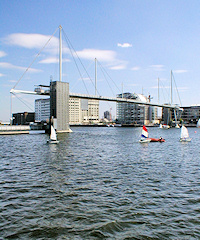
Shown in the photograph on the right, a high-level pedestrian bridge was constructed across the dock in 1999 to provide access to the DLR stations for residents of the new housing developments of West Silvertown.
Since June 2012 a cable car system has linked the Greenwich Peninsula (and the O2 Arena) with the Royal Docks (and the ExCel). In a ten-year sponsorship deal worth £36 million, the service is branded the Emirates Air Line – but it has been unglamourously nicknamed ‘the dangleway’. The cars have the capacity to carry up to 2,500 passengers per hour in each direction across the river but have failed to achieve anything close to that usage except on special occasions.
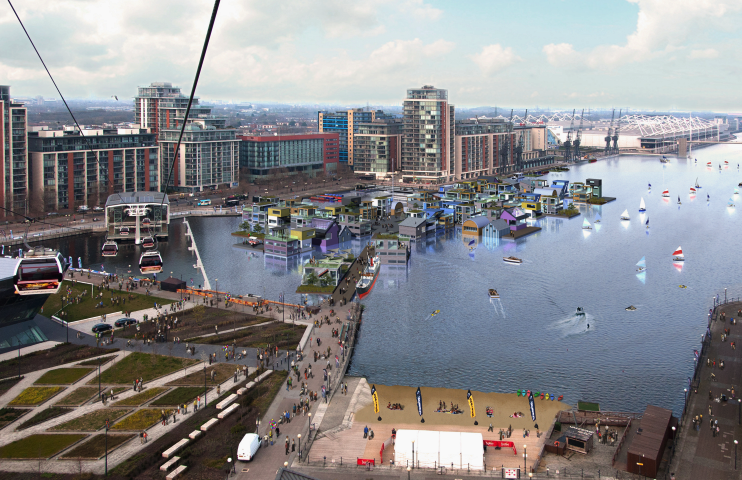
Directly to the east of the cable car terminus, 15 acres of the dock may become a waterborne community with floating homes, restaurants, cafes and bars, shown in the developers’ CGI image at the top of the page. As well as 50 residences for the lucky few, there would be a multi-purpose events space, a ‘blue water square’, a market square and what is being called a ‘floating corniche’. The proposed scheme takes its inspiration – and some technological know-how – from the floating homes at IJburg in Amsterdam.
Postal district: E16
Station: Docklands Light Railway, Beckton branch (Royal Victoria, zone 3)
Website: Royal Docks