
Russell Square
Russell Square, Camden
Central London’s second largest square, located to the north-east of the British Museum in Bloomsbury
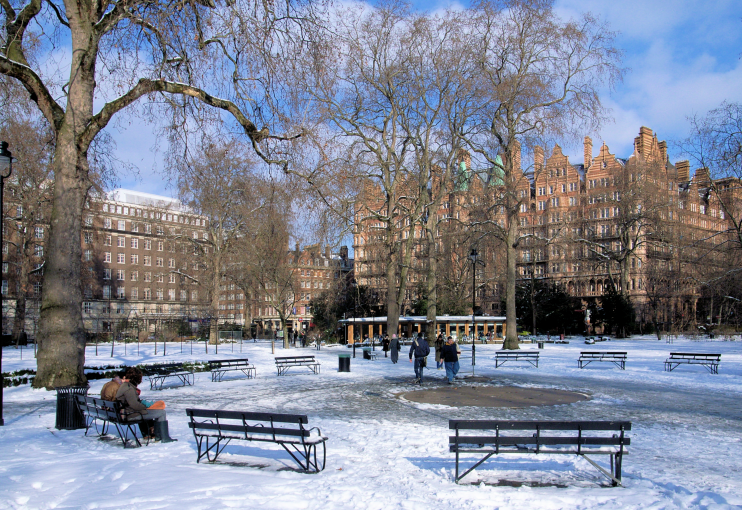
The Russell family, earls of Bedford from 1550, gained possession of Bloomsbury by marriage into the Southampton family in 1669. The area remained mostly open fields until the mid-18th century.
The square was laid out in 1801 by Humphry Repton on land earlier called Southampton Fields, and subsequently Long Fields. James Burton was the designer of the original buildings that surrounded the square, only a few of which now remain.
Russell Square quickly became one of London’s most desirable places of residence, home to the highest of high society. It is the prime setting for the events of Thackeray’s Vanity Fair, which is set at the time of the Napoleonic Wars. “But the tide of fashion has rolled westward,” wrote Charles Knight in 1843, “and left Russell Square to be inhabited by the aristocracy of the City and the Inns of Court.” Knight added that “the scientific section of London literary men” had been attracted here too, by the square’s proximity to the London University and the British Museum.
In 1852 the trustees of the British Museum proposed to extend the building north-eastward – a plan that would have involved buying and demolishing a number of houses in Montague Street and at the south-west corner of Russell Square. In the end they decided to create more internal space by filling in the central quadrangle, while at the same time moving the natural history collection to a new home in South Kensington.
A cabmen’s shelter was erected at the square’s north-western corner in 1897 – and survives to the present day.
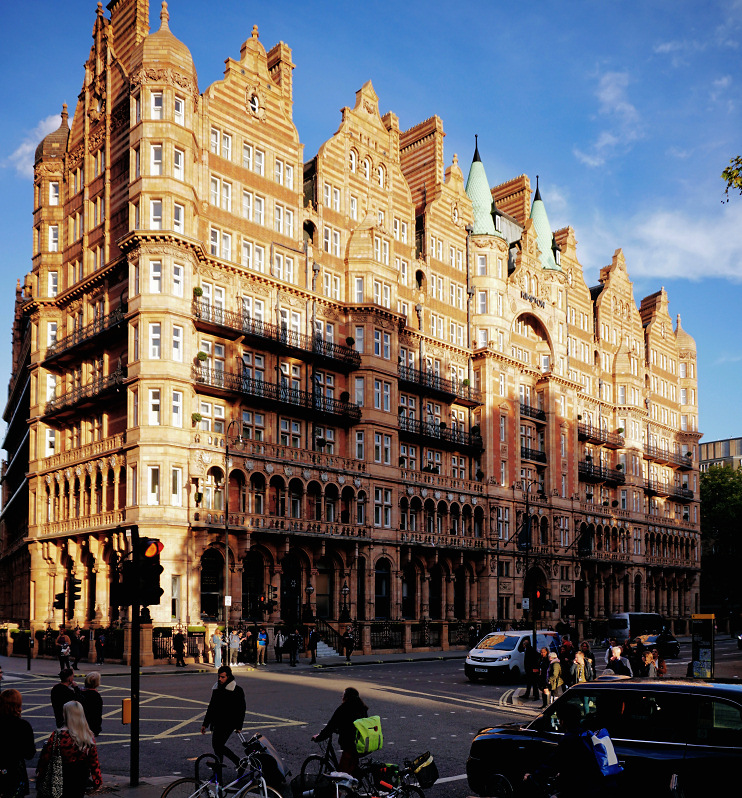
Built at the start of the 20th century, the Russell Hotel is a chateau-style terracotta extravagance, regarded as the finest work of the architect Charles Fitzroy Doll. The hotel is presently called the Kimpton Fitzroy London but hopefully it will one day regain its original name.
Russell Square Gardens were relaid in 2002, returning them to something like their appearance in the early 1800s by reproducing the original twisting paths and planting new lime trees. Low branches were removed from some older trees and the park was better lit and once again railed and gated.
Russell Square residents have included the poets William Cowper and Thomas Gray, the suffragette Emmeline Pankhurst and the theatrical impresario Richard D’Oyly Carte.
TS Eliot worked for nearly forty years for the publishers Faber and Faber at 25 Russell Square, a building now occupied by the School of African and Oriental Studies.
Postal district: WC1
Station: Piccadilly line (zone 1)
Web page: London Gardens Online, Russell Square Gardens