
Stockwell
Stockwell, Lambeth
An ethnically and socially diverse neighbourhood often regarded as the northernmost part of Brixton
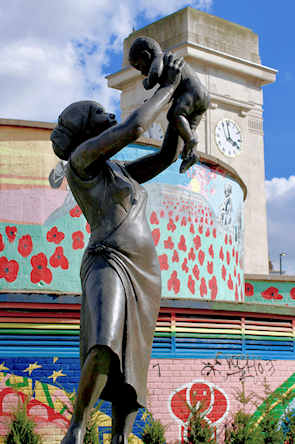
Stockwell’s name, which referred to a well-spring by a tree stump, was first recorded in 1197. Stockwell Green formed the focus of the settlement, with the manor house on its north side and a public well in the south-west corner. The Swan, the Plough and the Old Queen’s Head were the earliest public houses.
The manor house was demolished around 1755 and a new mansion was built, which survived for less than a century – a period in which Stockwell changed from a collection of nurseries with the usual scattering of grand houses into a nascent ‘villa land’. William Cox of Kennington began to develop Stockwell Park as a high class estate after 1838, whereupon several other builders pitched in with variations on his theme. Many of the villas were terraced or otherwise tightly packed – the secret of their survival to the present day.
Several public and philanthropic institutions arrived here during the 1860s, including an orphanage and a college. Commodious churches replaced cramped chapels. Stockwell Green was built over in the 1870s despite attempted resistance via the courts.
Stockwell became the southern terminus of London’s first deep tube line in 1890 but it was not until after the Second World War that the landscape was again transformed – this time by the construction of several large municipal estates, notably the LCC’s Stockwell Gardens (on the site of Stockwell College), the GLC’s Springfield, and Lambeth council’s Stockwell Park.
Stockwell gained tragic notoriety on 22 July 2005 when police wrongly identified Jean Charles de Menezes, a Brazilian electrician, as a suspect in the previous day’s failed attempts to set off bombs on three tube trains and a bus. When Menezes boarded a tube train at Stockwell, officers shot him seven times at close range without warning. In December 2008 an inquest jury returned an open verdict, after the coroner had ruled out unlawful killing as an option.
According to the 2011 census, 28.5 per cent of Stockwell’s residents are black or black British – down from a third in 2011. A quarter of the population is non-British white (up from 15 per cent in 2001), including a thriving Portuguese community.
The Stockwell ghost was a supposed poltergeist that created a great sensation in 1772. The author of the strange noises turned out to be Anne Robinson, a maidservant.