
White Hart Lane
White Hart Lane, Haringey
A thoroughfare winding between the High Roads of Tottenham and Wood Green, best known as the (nearby) home of Tottenham Hotspur, the Premier League football club
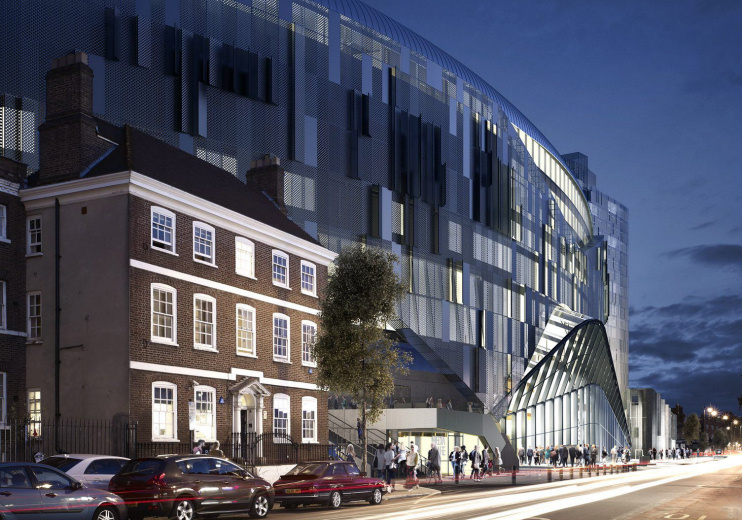
The road was in existence by 1619, when its western part was called Apeland Street. The White Hart inn stood on the east side of the High Road and was used for court sessions in the 1650s. Some very grand country retreats were built along the lane in the 17th and 18th centuries but settlement remained sparse until around 1810, when suburban villas gradually began to spread westward from Tottenham High Road.
White Hart Lane station opened on the Great Eastern Railway in 1872 and its vicinity soon took on a more urban character. The London County Council subsequently bought land between White Hart Lane and Lordship Lane for one of its first ‘out-of-town cottage estates’ – for more on this, see the page on Tower Gardens.
In the 1890s the White Hart’s landlord set up a nursery on the fertile soil behind the inn, but within a few years the newly professional Tottenham Hotspur football club sought to move the short distance here from its previous home. Originally Hotspur FC, and formed from an older cricket club in 1882, the club became Tottenham Hotspur two years later. Most of the founders were old boys of St John’s Presbyterian school and Tottenham grammar school.
In the days before the stadium became all seated (in 1994) the ground witnessed some huge attendances – most notably in the 1948–9 season, when the record gate of 75,038 was achieved for a match against Sunderland. The old ground’s capacity in its latter days was 36,284.
Since 2019 the club has had a new stadium, built as part of a scheme that was codenamed the Northumberland Development Project because the site borders the avenue called Northumberland Park, which in turn is so called from the former ownership of the land thereabouts by the dukes of Northumberland. The pièce de résistance is the stadium’s 17,500-seat south stand – the largest single-tier stand in the UK.
Other aspects of the Northumberland Development Project were originally proposed to include:
- A visitors’ centre with an interactive museum, cinema, club megastore, ticket office and café
- An enhanced public open space, comparable in area to Trafalgar Square, with a multi-use games area
- A 180-bedroom hotel with 49 serviced apartments on the upper floors
- A new building to host extreme sports, including the world’s highest indoor climbing wall
- A ‘Sky Walk experience’ that involves walking on top of the stadium
- 579 new homes in four blocks, including affordable housing
- A new community health centre
Several of these features have yet to make an appearance. In February 2023 the club announced: “The Northumberland Development Project is now substantially complete with Lilywhite House and the opening of the Tottenham Hotspur Stadium. There are a number of projects at the southern end of the site (hotel and residential) which will be ultimately developed when appropriate” – from which it may be inferred that the project’s final form may be quite different from the original proposals.
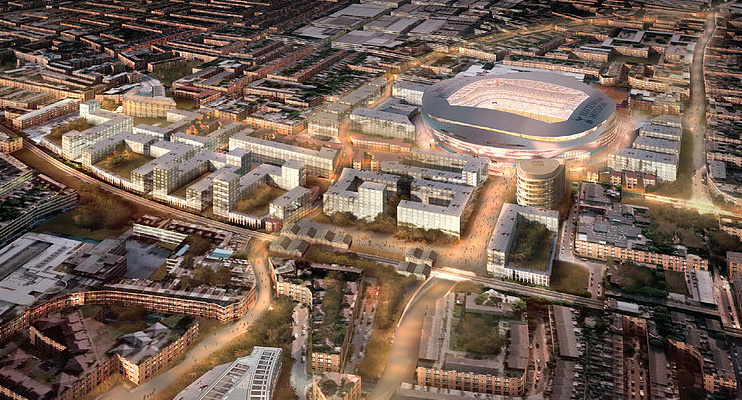
In addition, the 27-acre High Road West scheme will bring another 2,500 new homes to the zone either side of the eastern end of White Hart Lane, plus a library and a small park. However, a number of existing properties will be demolished, including homes on the Love Lane estate. An early CGI of the High Road West masterplan is shown above – but the final scheme is likely to rise higher.
Postcode areas: N17 and N22
Population: 13,431 (2011 census)
Station: London Overground (zone 3)
Mike Donovan, Glory, Glory Lane: The Extraordinary History of Tottenham Hotspur’s Home for 118 Years, Pitch Publishing, 2017
Website section: Spurs’ new stadium