
London football geography
The geography of London football
The top 20 London clubs in 2023–24
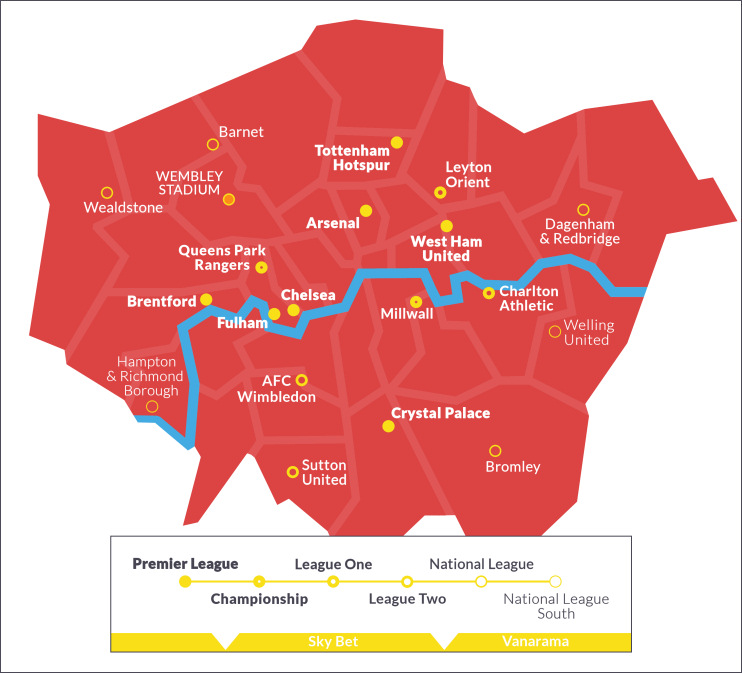
The twelfth edition of Hidden London’s football map shows the ground locations for all the London clubs in the top six tiers of the English game for the 2023–24 season.
The weight of the type and the density of the map’s yellow circles indicate hierarchical status, from the Premier League clubs to those in the National League South (formerly Conference South). The map also shows the location of Wembley Stadium – the home of cup finals and England games.
The map reflects just two changes from the 2022–23 season:
- After ending last season as champions of EFL League Two, Leyton Orient were promoted to League One.
- Dulwich Hamlet finished fourth-from-bottom of the National League South and were relegated to the Isthmian League Premier Division, so the club has been removed from the map – and from the table below.
These are the 19 London clubs mapped above, listed alphabetically within each division:
| League/Division | Club | Ground |
|---|---|---|
| Premier League | Arsenal | Emirates Stadium |
| Premier League | Brentford | Gtech Community Stadium |
| Premier League | Chelsea | Stamford Bridge |
| Premier League | Crystal Palace | Selhurst Park |
| Premier League | Fulham | Craven Cottage |
| Premier League | Tottenham Hotspur | Tottenham Hotspur Stadium |
| Premier League | West Ham United | London Stadium |
| Championship | Millwall | The Den |
| Championship | Queens Park Rangers | Kiyan Prince Foundation Stadium, Loftus Road |
| League One | Charlton Athletic | The Valley |
| League One | Leyton Orient | Breyer Group Stadium, Brisbane Road |
| League Two | AFC Wimbledon | Plough Lane |
| League Two | Sutton United | Borough Sports Ground, Gander Green Lane |
| National League | Barnet | The Hive |
| National League | Bromley | Hayes Lane |
| National League | Dagenham & Redbridge | Chigwell Construction Stadium, Victoria Road |
| National League | Wealdstone | Grosvenor Vale |
| National League South | Hampton & Richmond Borough | Beveree Stadium |
| National League South | Welling United | Park View Road |
After yo-yoing between the Premier League and the Championship in previous years, Watford FC are spending their second consecutive season in the Championship. Watford are based at the Vicarage Road stadium, which is located two and a half miles (4km) beyond the north-west edge of Greater London.