
Gunnersbury
Gunnersbury, Hounslow
A tube station, park and a pair of mansions situated in the far north-western corner of Chiswick
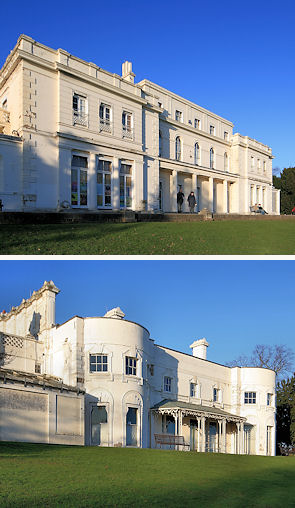
Gunnersbury is one of the few places in London to have been named after a woman, in this case Gunnhildr, whose manor this was. There is no evidence for the suggestion that she was a niece of King Canute but she may have had Danish blood.
Gunnersbury House was a Palladian mansion built in the mid-17th century for Sir John Maynard, the king’s principal serjeant-at-law. Princess Amelia, daughter of George II, made the villa her summer residence from 1762 to 1786.
The estate was sold in 1800 and the house was demolished and replaced by Gunnersbury Park and Gunnersbury House, later called the Large Mansion and the Small Mansion.
In 1835 Gunnersbury Park was acquired and then enlarged by the banker Nathan Mayer Rothschild. His nephew Leopold de Rothschild bought Gunnersbury House in 1889 and put it to use as a guest house for visitors to Gunnersbury Park, who included Edward VII.
After Leopold’s death in 1917 the estate was split up. Part was sold for building, while the local boroughs bought the mansions and 186 acres of parkland. The Large Mansion is home to Gunnersbury Park Museum, which displays Ealing and Hounslow’s local history collections. The Small Mansion is mostly in a state of disuse.
In 2014 the Heritage Lottery Fund and Big Lottery Fund made a grant for the restoration of and improvements to the landscape and buildings of Gunnersbury Park. The museum reopened in June 2018 and the overall ‘transformation’ is due for completion in 2026.
Gunnersbury station (originally Brentford Road) was rebuilt in 1966 with an 18-storey office block above, now occupied by the British Standards Institution.
The Russian Orthodox Cathedral stands on Harvard Road, just south of the station. It was built in 1998 in the traditional ‘Pskov’ style, with an onion-shaped dome painted in blue with gold stars.
Gunnersbury Triangle is a six-acre nature reserve on Bollo Lane, situated between railway lines. It has birch and willow woodland with an attractive pond, marsh and meadow, but not much in the way of rare species.