
Globe Town
Globe Town, Tower Hamlets
A collection of council-built properties located near the western end of Roman Road, east of Bethnal Green
A track running north from Stepney was called Theven Lane in the Middle Ages, from the Old English plural of ‘thief’. By the early 18th century it had been renamed Globe Lane, and later Globe Road, probably after a local inn.
In the 1790s land on the Eastfields estate was developed by a consortium of builders and the scheme had become known as Globe Town by 1808.
More houses were added in the 1820s, which although small were well-built and aimed at a middle-class market.
Globe Road and Devonshire Street station opened on the Great Eastern Railway in 1884 and closed in 1916. Inevitably for this part of east London, Globe Town had by this time become very run-down and it suffered the loss of many houses, factories and a church in the Second World War.
In the late 1940s the borough council built the Rogers estate, named after a local war hero. This was followed by a succession of municipal projects that changed the face of Globe Town over the following three decades.
In 1992 the crime-ridden Rogers estate was London’s first to benefit from a government initiative called the ‘design improvement controlled experiment’ but the improvements were not sustained and the flats soon resumed their deterioration. Since then, housing associations have taken over the management of many of Globe Town’s flats, while others have been sold privately.
Globe Town has a large Bangladeshi community, as well as Turkish, Arabic and Cantonese speaking minorities. The ward’s population grew by almost 30 per cent between the 2001 and 2011 censuses.
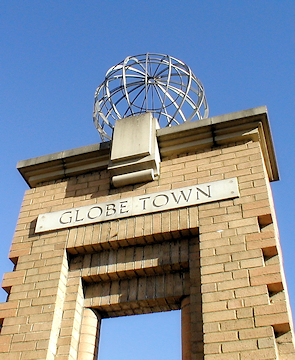
As a result of Tower Hamlets’ short-lived division into seven ‘neighbourhoods’ in the 1980s, Globe Town is the most strongly branded locality in London, with skeletal steel spheres mounted on brick columns or flat arches at all main access points.
Postal district: E2
Population: 15,190 (Mile End and Globe Town ward, 2011 census)
Further reading: Anne Cunningham, Glimpses of Globe Town, Globe Town Neighbourhood Libraries Service, 1988
and Gerry Stoker and Vivien Lowndes, Tower Hamlets and Decentralisation: The Experience of Globe Town Neighbourhood, Local Government Management Board, 1991