
Stamford Hill
Stamford Hill, Hackney/Haringey
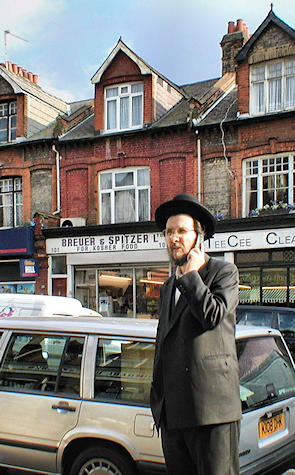
Located north of Stoke Newington, Stamford Hill is one of London’s most distinctive quarters, with its highly independent community of perhaps 20,000 Hasidic (Haredi) Jews
In the 13th century this was Sandford Hill, where a sandy ford crossed a tributary of the river Lea. In the late 18th and early 19th centuries its elevated situation attracted wealthy merchants, notably Moses Vita Montefiore, an Italian Jew who died here in 1789.
The arrival of trams and trains in 1872 set off a 20-year building programme that established the present layout of Stamford Hill, including shops on Dunsmure Road by 1884. From this time onwards, and particularly after the 1920s, upwardly mobile Jews came here from the East End, as they did to Dalston and Stoke Newington. Several synagogues were relocated or founded here. Some larger old houses were converted for use as Jewish schools or other institutions, while their grounds were split into lots and sold off for further housebuilding.
The London County Council and the Guinness Trust built estates in the 1930s. The LCC added more blocks after the war, as did the Samuel Lewis Trust. This was a period of Hasidic Jewish immigration from eastern Europe, creating a ‘square mile of piety’ at Stamford Hill.
The Hasidic Jews of Stamford Hill used to be referred to as ‘ultra-Orthodox’ but the term ‘Haredi’ is increasingly preferred nowadays.
The Haredim have their own schools, conventicles and kosher food shops. They wear 18th-century frock coats and black hats and are the sole British Jewish group still to speak Yiddish. Only New York has a larger community of Haredi Jews outside Israel.
The Haredi community’s high birth rate has led to cases of overcrowding, and many houses have been dramatically extended upwards or into back gardens to accommodate large families, causing local controversy.
In September 2014 Hackney council removed posters in Hebrew and English telling women which side of the road they should walk on, though the kerfuffle was – to some degree – the consequence of a misunderstanding.
Stamford Hill also has residents of black African, black Caribbean, Turkish and Kurdish heritage.
Because of Stamford Hill’s unique character it has been the subject of several TV documentaries and dramas, including the 1993 BBC play Wall of Silence, which caused controversy with its portrayal of a psychopathic Hasidic murderer, played by Warren Mitchell.
Stamford Hill was the fictional home of Marcus, the young prodigy in Madam Sousatzka, Bernice Rubens’s 1962 novel.