
Kingsbury
Kingsbury, Brent
A mixed Metroland and municipally built suburb covering a large area north-east of Wembley and west of Hendon
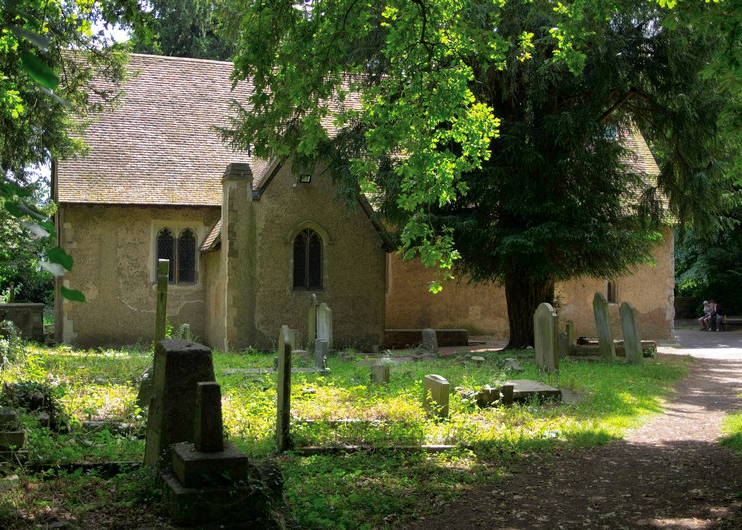
Known in ancient times as Tunworth, Kingsbury was mentioned in Domesday Book as Chingesberie, which meant ‘king’s manor’, although whatever royal connection it may have had seems to have been lost by the time the Normans arrived.
Shown in the photograph above,* the disused twelfth-century church of St Andrew gives an indication of Kingsbury’s significance as a medieval settlement. It is the only grade I listed building in the borough of Brent.
The settlement’s evolution has seesawed between its southern and northern extremities. Kingsbury was first a village beside Black Pot Hill (now Blackbird Hill, near the bottom right corner of the map below) and Kingsbury Green was a hamlet one mile to its north. Kingsbury was severely affected by the Black Death. The old village was largely abandoned; a new one grew up around Kingsbury Green and by the late 19th century the original village was almost forgotten.
Victorian development was substantial enough for Kingsbury to break away from Wembley in 1900 as an independent urban district. However, the separation lasted only 34 years and the district remained predominantly rural until well into the 20th century.
In the 1920s the presence of Neasden station (originally called Neasden and Kingsbury) stimulated Metroland growth in the southern part of Kingsbury and the population increased eightfold in ten years.
Immediately after this came the construction of the last stage of the Metropolitan Railway, from Wembley Park to Stanmore, and the opening of the underground station west of Kingsbury Green in 1932, whereupon the town’s centre of gravity shifted once more.
Two churches of St Andrew now share the same churchyard at the south end of Church Lane. The newer St Andrew’s was erected as a result of the massive growth in the area’s population following the opening of Neasden and Kingsbury station. Formerly an Anglo-Catholic church located in Wells Street in the parish of St Marylebone, and conveniently already called St Andrew’s, it was transported to Kingsbury stone by stone in 1933.
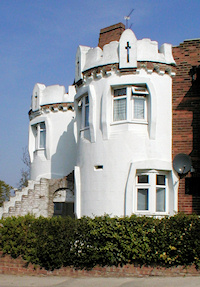
The Belfast-born architect Ernest Trobridge lived in Kingsbury from 1915 until his death in 1942 and he designed homes in several distinctive styles, often using innovative materials. His most extraordinary creations, all built in the mid-1930s, were small blocks of flats designed to look like castles, with turrets that disguised chimneys and battlements around roof gardens. To learn more about Trobridge, Hidden London recommends Brent council’s illustrated guide, From Cottages to Castles: A walk around Trobridge’s Kingsbury [PDF]. However, because Kingsbury is not a highly desirable area, many of Trobridge’s enchanting homes are not in the condition in which they deserve to be.
After the Second World War, Wembley council built a major housing estate, destroying most of Kingsbury’s historic buildings in the process. Since then, there have been few significant alterations to the built environment but the demographic profile has changed radically: almost 3,000 residents (more than 20 per cent) of Fryent (Kingsbury’s main ward) are of Indian origin or descent. The ward also has more than 1,000 eastern European residents.
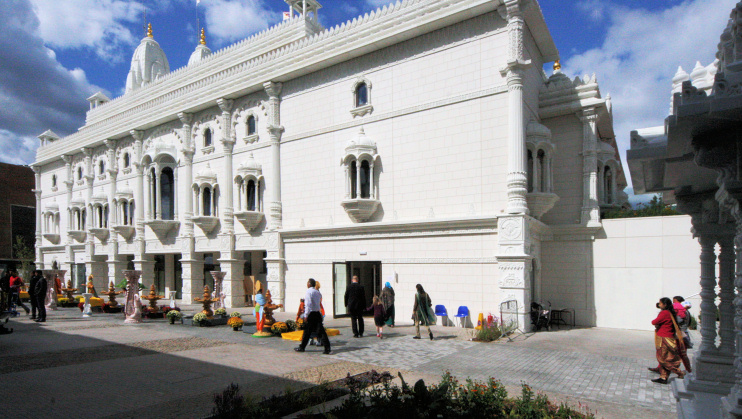
Shown in the photograph above, Shree Swaminarayan Mandir Kingsbury opened in August 2014 at the corner of Townsend Lane and Kingsbury Road. The neighbouring Shree Muktajeevan Swamibapa complex hosts a variety of cultural, artistic, sporting, educational and charitable activities.