
Hackney Wick
Hackney Wick, Hackney/Tower Hamlets
This hitherto run-down Leaside area, divided from the rest of Hackney by the East Cross Route, is presently exhibiting a flowering of cultural creativity
A ‘wick’ often signified an outlying dairy farm and the ‘ferm of Wyk’ was recorded in the 13th century.
By the late 18th century the small hamlet had gained a silk factory and the Wick went on to play a distinguished role in east London’s industrial history. The use of the word ‘petrol’ was pioneered in Hackney Wick – by Carless, Capel and Leonard, who carried on their refining business here for over a hundred years from 1860. Among the district’s many other claims to industrial fame, Matchbox toys were made at Lesney’s factories, Clarnico (Clarke, Nickolls and Coombs) was the country’s largest confectioner and the Lion Works housed activities by the entrepreneur Achilles Serre, who introduced dry-cleaning to England.
However, the growth of industry contributed to social decline in Hackney Wick, which was described in 1879 as a district of 6,000 people who had sunk to the lowest depths, and it became notorious for its jerry-built housing. The parish church of St Mary of Eton with St Augustine was founded in 1880 by Eton College, which wanted to perform charitable work in a poor part of London.
From the 1930s the municipal authorities set about improving conditions in Hackney Wick, opening public baths and a library and clearing slums to put up blocks of flats, notably in the 1960s. Several eyesores built during that period have already been torn down: St Mary’s Village has replaced the tower blocks of the Trowbridge estate with a mixed tenure development of houses and flats.
Hackney Wick did not gain its station (originally intended to be called Wallis Road) until 1980, when the North London line was reopened to passenger services, although it had earlier been served by a station at Victoria Park.
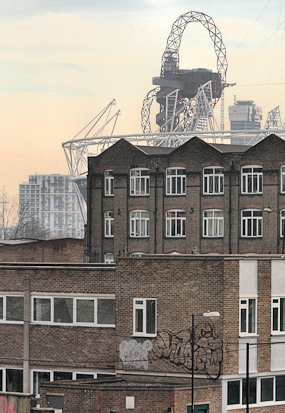
After a period of stagnation, several sites in Hackney Wick have recently been undergoing regeneration and the proximity of the Olympic Park has enhanced the locality’s appeal.
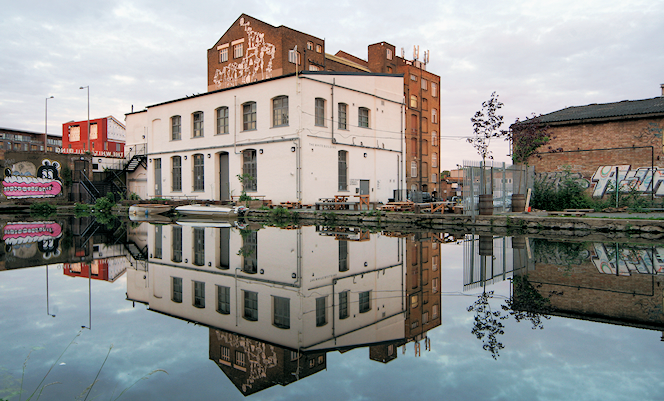
Numerous artists and designers have set up studios here – and in neighbouring Fish Island – in old warehouses and disused industrial premises – and a canal-side centre for art, technology and sustainability called the White Building opened in 2012. It’s shown in the image at the top of this page.
The Wick’s new-found cultural effervesence is showcased in exhibitions, open studios and curated events organised by the Hackney WickED community interest company.
Many homes in Hackney Wick are rented from a social landlord or from the council, and significant pockets of poverty persist in the locality. However, at least part of the Wick has been undergoing “rampant gentrification” – as the Hackney Gazette described it – which is often the stage that follows the arrival of a creative community.
Postal district: E9 and E15
Population: 11,734 (Hackney’s Wick ward, 2011 census)
Station: London Overground (Zone 2)
Further reading: Vicki Cattell and Mel Evans, Neighbourhood Images in East London: Social Capital and Social Networks on Two East London Estates, Joseph Rowntree Foundation, 1999